
Which Peanuts Character Are You?
This quiz measures how you behave when Peanuts turns a small childhood problem into a moral weather system. Choose what you would actually do around Charlie Brown, Snoopy, Lucy, Linus, and the rest, and you will land on the character whose habits look most like yours.

About Peanuts
Peanuts is a long-running humor comic book from Holt, Rinehart and Winston, begun in 1950 and listed with 2,239 stories. Its small cast of children, plus Snoopy the beagle and his bird friend Woodstock, handles friendship, nerves, crushes, private rituals, and the peculiar dignity of losing in public. It centers Charlie Brown’s self-doubt, Lucy’s force, Linus’s blanket and Great Pumpkin faith, Schroeder’s piano, and the tangled loyalties around them.
How this quiz works
Answer 10 questions. There are no right or wrong answers — each choice adds points, and the result you get is the one your answers point to most.
10 questions · 8 possible results · about 3 minutes
Start the quizOne question at a time. Nothing is saved, and you can start over whenever you like.
Meet the characters from Peanuts
Every result below is a real ending of this quiz — read them before or after you play.

Charlie Brown
Charlie Brown is one of the featured Peanuts children, recognizable for his round, big head, sparse hair, and a habit of approaching the world with apprehension. He is often short on self-confidence, but he remains present in the group’s ordinary humiliations and small hopes.
Around stronger personalities like Lucy, he tends to become the person everyone measures pressure against. You behave like the person who expects the ball to land badly and still walks toward it. When an attempt goes wrong, you do not pretend the failure is glamorous; you check the damage, absorb the silence, and try to give everyone a way back into the next attempt. You are often most useful when nobody wants to be seen needing help, because you already know what public awkwardness costs. That is why Charlie Brown fits: apprehension is present, but it does not get the final vote every time. The danger is that you can start treating discouragement as proof of character rather than as a problem to challenge. If you keep volunteering to be the safest target, other people may mistake your endurance for consent and never learn to carry their own embarrassment.

Snoopy
Snoopy is the beagle at the center of many Peanuts disturbances, adopted from Daisy Hill Puppy Farm after his early home with Lila ended. He is not another child, but he moves through their world with equal narrative weight.
His presence bends errands, games, and moods away from the strictly sensible, usually without asking permission first. You answer pressure by making the scene larger than the problem that started it. If the afternoon is stale, you introduce ceremony; if everyone is taking a small defeat too seriously, you shift the rhythm until the embarrassment has less room to stand. You are good at giving people an exit that does not require a direct confession, which is useful among children who would rather be dramatic than honest. Snoopy fits because you do not always accept the local definition of reality. The catch is that charm can become evasion if you use it every time responsibility appears. Someone still has to gather the scattered belongings, explain the misunderstanding, or admit that the plan failed. If you float above those duties too often, the people who enjoy your performance may also become the people quietly cleaning up after it.

Lucy Van Pelt
Lucy Van Pelt is a black-haired featured character, Linus’s older sister, and a force who often bullies Charlie Brown. Her unrequited crush on Schroeder puts a softer problem beside her sharper habits.
Lucy tends to occupy the center of any exchange, diagnosing, demanding, and treating other people’s hesitation as something she has been appointed to correct. You step in before uncertainty has finished gathering its materials. In a confused game, a stalled conversation, or a crowd pretending not to know what it wants, you name the problem and start moving people into position. You would rather be blamed for pushing too hard than watch everyone sink into helpless politeness. Your care often arrives wearing boots, because soft shoes take too long. Lucy Van Pelt fits because you understand that indecision can become its own kind of cruelty. The cost is that your help can feel indistinguishable from control, especially to someone already nervous. If every scene requires your verdict, people may begin hiding their mistakes, their crushes, or their strange hopes from you. Being right is not the same as being safe to stand beside.

Linus Van Pelt
Linus Van Pelt is Charlie Brown’s good friend, Lucy’s younger brother, and the child most closely tied to his security blanket. He believes fully in the Great Pumpkin, which gives his private faith a public test.
Linus often behaves like someone who can be gentle and stubborn at the same time, holding comfort and conviction in both hands. You keep a private center even when the group treats it as inconvenient. Under pressure, you look for the one thing that steadies the room: a promise, a ritual, a blanket corner, a reason not to laugh at someone who is exposed. You can stay with another person’s odd belief longer than most, not because you are easily persuaded, but because abandonment feels like a careless answer. Linus Van Pelt fits because you combine tenderness with a surprisingly durable line in the sand. The risk is that loyalty to a symbol can turn into refusal to revise the situation in front of you. Waiting can be noble, but it can also become a way to avoid choosing. If comfort is never questioned, it may stop being shelter and start becoming the border of your world.

Schroeder
Schroeder is a blonde-haired boy in a short-sleeved shirt with black stripes, known for his skill at the piano and his intense love of music. In Peanuts, he is often defined by attention: to notes, practice, and the space required to keep playing.
Around Lucy, that concentration becomes both refuge and boundary. You reduce disorder by returning to the work itself. If everyone is arguing, you find the passage that needs practice, the rule that makes the game playable, or the quiet place where effort can resume. You are not especially interested in being the loudest person present. You prefer to make something sound right, line up properly, or hold its form while the surrounding commotion tires itself out. Schroeder fits because discipline is your way of staying intact. The drawback is that devotion can become a locked door with music coming from the other side. People who do not understand your focus may still need an answer, and people who interrupt you are not always enemies of the work. If you treat every emotional demand as noise, you may protect your concentration while losing the conversation.

Sally Brown
Sally Brown is Charlie Brown’s younger sister, a blonde girl with curls on top and a pronounced crush on Linus Van Pelt. She enters Peanuts through family closeness and lopsided affection, often wanting the world to answer her directly.
Her behavior tends to turn small misunderstandings into personal negotiations, which is not always inefficient. You approach desire as something that should not require a committee. If you want reassurance, an explanation, or a moment with the person you have chosen, you move toward it and expect the room to respond. You can make adults and children alike deal with the feeling they hoped to postpone. Your logic may be sideways, but it has a useful talent for exposing what everyone else is circling. Sally Brown fits because your wants have a clear address, even when your methods wander. The downside is that directness can crowd the person receiving it. A crush, a complaint, or a shortcut through a difficult task may feel obvious to you and exhausting to someone else. If you mistake intensity for mutual understanding, you may win the floor and still miss what the other person was trying to say.

Peppermint Patty
Peppermint Patty is a stringy-haired, big-nosed Peanuts girl who has a crush on Charlie Brown and calls him “Chuck.” She is also closely tied to Marcie, her best friend. Her behavior reads as forward motion: she enters a situation, names it in her own terms, and expects everyone else to discover the plan while already participating.
You move before the map has been drawn. Faced with a contest, a dare, or a murky group plan, you would rather collide with the first obstacle than spend the afternoon discussing possible obstacles. You bring momentum to children who are stuck in analysis or dread. Your confidence is partly practical: once people are running, they stop pretending the problem can be solved by staring at it. Peppermint Patty fits because you trust action to reveal what instructions conceal. The problem is that other people may not have agreed to be swept along. Your pace can flatten quiet objections, details, and the person in the group who was trying to translate the rules. If you never pause to check consent or accuracy, you may call it leadership while everyone else calls it surviving your latest idea.

Marcie
Marcie is a short-haired girl with big glasses that keep her eyes from being seen, and she is Peppermint Patty’s best friend. She belongs to the side of Peanuts where friendship often requires interpretation.
Because Patty moves with such force, Marcie’s behavior often feels like steadiness by contrast: listening, clarifying, and staying near without becoming identical. You make confusion legible. When someone energetic drags the group into an unexplained scheme, you listen for the actual task beneath the noise and translate it into steps people can follow. You notice who has misunderstood, who has been volunteered, and who is pretending to understand because it is less embarrassing. Your loyalty is not passive; it works by making the situation less foolish than it was when it arrived. Marcie fits because you can stand beside a stronger gust of personality without becoming only its echo. The hazard is that competence can hide your own wishes from everyone, including you. If you are always interpreting, smoothing, and rescuing the plan, others may assume you require nothing in return. Clear sight is useful, but it can become lonely when you never ask to be read as carefully as you read the room.
More like this

Which Suicide Squad Character Are You?
This quiz measures how you behave when a Suicide Squad mission turns sour: what you protect, what you use, and what you are willing to become useful for. Answer from inside the field, and you will get the character whose kind of pressure most resembles yours.

Which The Thing Character Are You?
This quiz measures how you act when The Thing’s Marvel New York turns into a rescue problem: who you protect, when you move, and how much planning you need before the pavement gives way. Your result matches you with a character whose habits fit your choices, including the part of that habit that may cost you.

Which Green Arrow Character Are You?
This quiz measures how you behave when a masked rescue turns into a question of loyalty, grief, and who gets protected first. Answer as you would act in the Green Arrow world, and you will be matched with the character whose pressures most resemble yours.
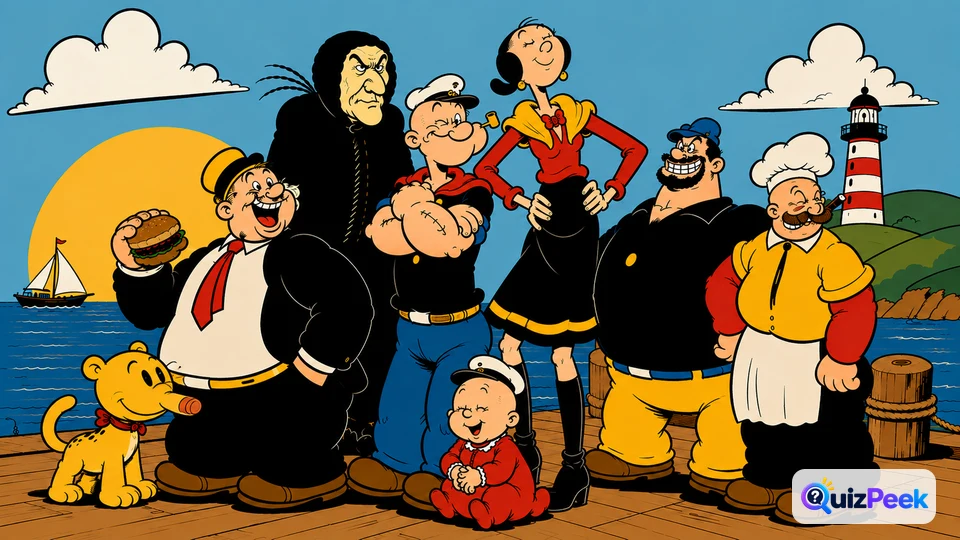
Which Popeye Character Are You?
This quiz drops you into Popeye's comic world of café quarrels, Oyl-family confusion, old rivalries, and suspicious errands. Choose what you would actually do, and your result points to the character whose habits most resemble yours.


